Santa Fe
The Constant PrincessSanta Fe was a stone town built around the Christian camp during the siege of Granada, transforming a makeshift military encampment into a durable base for the royal family and the army. Its construction demonstrated Isabella of Castile’s resolve to continue the siege, but the town’s place in the story also carries a darker contrast: the Christian victory and its promises of coexistence gave way, in the narrator’s account, to religious coercion.
From camp to town
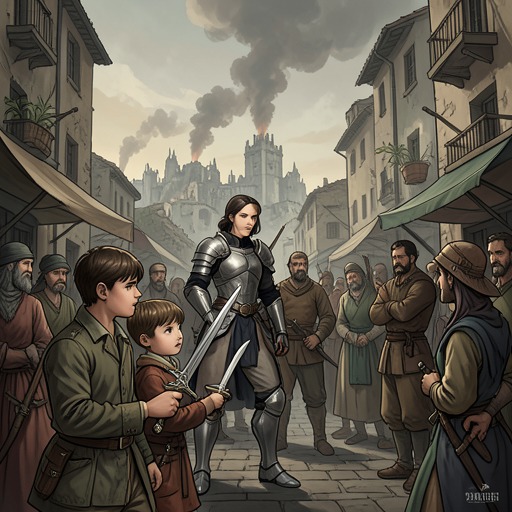
The settlement took shape under difficult conditions: the Christians worked through hot spring days and cold nights, building in stages while the siege continued. The undertaking seemed unlikely to succeed, yet the camp became a little town of stone. Its name marked the achievement, not the end of the military campaign: the account stresses that the siege of Granada would continue.
The contrast between the small camp and the town it became gives Santa Fe its narrative force. The settlement was a practical answer to the demands of a prolonged siege, and its construction turned persistence into a visible presence on the ground. The camp had not merely endured; it had acquired the buildings and stores of a place intended to support continued operations.
Buildings and provisions
The first chapel was built in a round form like a mosque, using a design local builders could construct quickly. A small, flat-roofed house followed, set within an Arabic courtyard for Ferdinand, Isabella, and their family. Isabella asked only for a roof and walls, having spent years at war and expecting no luxury. Around the royal shelter, the great lords took refuge in a dozen stone hovels.
Military necessities shaped the next phase. Stables were built for the horses, and secure storage was provided for gunpowder and explosives. Isabella had pawned her own jewels to buy those supplies from Venice. Only after these essentials came barracks, kitchens, stores, and halls. The order of construction makes the settlement’s priorities plain: shelter for the royal household and leading lords, protection for valuable military supplies, and then the facilities needed to house and provision the wider force.
Isabella’s determination
The account presents the building project as another instance of Isabella overcoming misfortune. She had asked for modest accommodation, but she also ensured that the camp acquired the infrastructure required to keep the siege going. The use of her pawned jewels for explosives connects royal resources directly to the war effort; Santa Fe’s stone buildings were not an ornamental courtly project but part of a campaign sustained by practical provisioning.
The town’s success is expressed in the reversal from expectation to accomplishment: what no one thought could be done was done. Yet this achievement did not resolve the conflict. The settlement made the Christians’ continued presence possible, while the siege itself remained unfinished.
Conquest and its moral aftermath
Santa Fe belongs to a narrative of Christian military expansion, but the story later sets that expansion against the fate of the people promised protection after Granada’s conquest. The narrator recalls the pledge that Muslims would be safe under Christian rule and the promise of convivencia, a society in which Muslims, Christians, and Jews could live with dignity. That promise was broken within three months: Jews were expelled, Muslims were threatened, and conversion became a condition of belonging.
The narrative does not identify these later policies as actions carried out in Santa Fe. Rather, the settlement’s significance lies in its position within the larger sequence: it was built to sustain the siege that continued toward Christian victory, while the victory’s claimed religious purpose sits uneasily beside the coercion that followed. Santa Fe is both a concrete work of military endurance and a reminder that successful conquest did not secure the coexistence its rulers had promised.